There is a deep frustration across Ghana that can no longer be ignored.
Across public institutions in Ghana, citizens are facing the same harsh reality: the system that is meant to serve them is no longer working as it should. What should be a clear, predictable, and accountable process has been overtaken by informal dealings, personal connections, and unofficial payments.
Let us state it plainly.
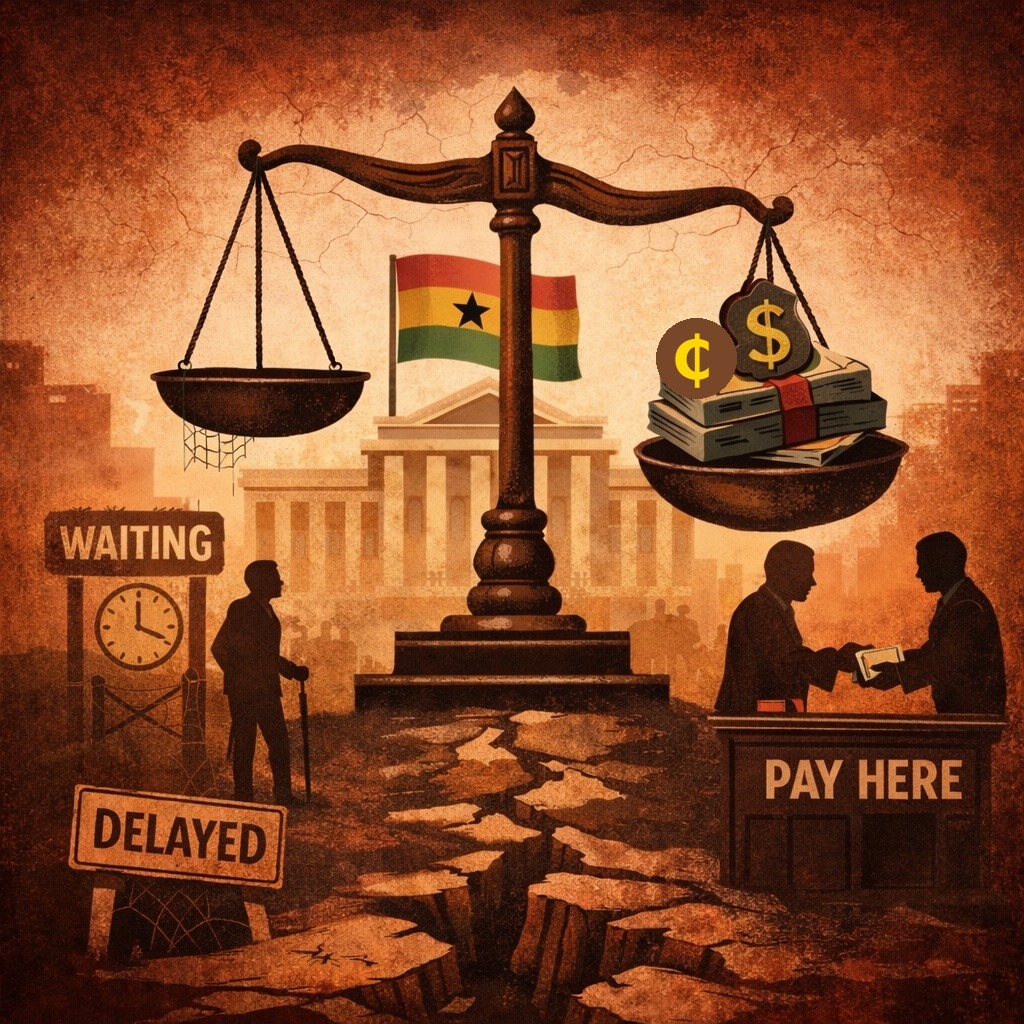
In many instances, you cannot rely on the official process alone. Files do not move because they are properly submitted. They move because someone has been “seen.” Applications are not processed based on order. They are processed based on who has paid. And what should cost a fixed, official fee ends up costing two or three times more because every personnel who touches the process expects to be settled.
This is not an exaggeration. It is the lived experience of many citizens. And the truth is, people are tired.
Tired of being delayed.
Tired of being ignored.
Tired of being subtly; and sometimes openly pressured to pay before anything happens.
For many, the “back door” is no longer a choice. It is a survival mechanism within a broken system.
But what happens to those who cannot pay? They wait – they wait weeks; they wait months. Sometimes, they wait indefinitely. Their applications sit untouched. Their files gather dust. And in some cases, they are forced to start all over again because there is no proper tracking, no accountability, and no one responsible for ensuring that their matter is handled.
You are considered lucky if your application is even looked at without making an unofficial payment. This creates a deeply unjust system; one where access to public services is no longer based on rights, but on ability to pay. It excludes the vulnerable, penalises integrity, and rewards misconduct.
If nothing is done, the consequences will be severe.
Firstly, public trust in government institutions will continue to erode. When citizens no longer believe that systems work, they disengage from them. And once that trust is lost, it is extremely difficult to rebuild.
Secondly, corruption will become fully institutionalised. What is currently seen as “how things are done” will harden into an accepted norm, making reform even more difficult in the future.
Thirdly, inequality will deepen. Those with money or connections will continue to access services quickly, while ordinary citizens are left behind. Public service will no longer be public; it will be selective.
Fourthly, economic activity will suffer. Delays in processing permits, registrations, land documentation, and other services slow down business, discourage investment, and increase the cost of doing business in Ghana.
Finally, the credibility of the State itself is weakened. A government that cannot enforce its own processes risks losing authority over them.
This is not sustainable. Government must act decisively and urgently.
First, it must take back control of its processes. Every application must pass through a system that is structured, trackable, and transparent. No individual should have the power to hold or delay a file without accountability.
Second, all payments must be strictly formalised. Every payment must go through an official channel with a verifiable receipt.
Third, enforcement must be real and visible. Officers who engage in unofficial dealings must face consequences that are swift and clear. Quietly moving people around does not solve the problem, it spreads it.
Fourth, leadership across agencies must be held accountable. If an institution becomes known for back door dealings, its leadership must answer for it.
Fifth, citizens must be protected. Reporting channels must be accessible, and complaints must lead to action. Choosing to do the right thing should not result in punishment through delay or neglect.
Finally, there must be a reset in the culture of public service. Public office is a trust, not an opportunity for personal gain. That principle must be enforced at every level.
The reality is simple: people will use the system when the system works.
But right now, too many people feel that it does not.
And until government fixes that, the gap between what is supposed to happen and what actually happens will continue to grow.
This is the moment to act, before the system is no longer recognised as a system at all.
Share your thoughts